

People choose homeschooling for several reasons, including broadening the opportunities for learning and increasing flexibility.
One of the main reasons for homeschooling is the ability to get creative in your approach and cover subjects outside your state's standard curriculum.
So, when considering if homeschooling is a good option for you, it's vital to consider your circumstances, including the time and space you have, where to find resources, and the approach that best meets the student's individual learning style.
Then, you need to find the right homeschool curriculum to help map out what to cover and when.
To help you choose the right approach to homeschooling and find the curriculum for you, this guide will cover:
- Types of homeschooling
- Choosing the right curriculum
- Sitting exams
- Notifying your school district
Types of home education
As you might expect from a type of education renowned for its flexibility, there are a variety of different approaches to homeschooling and home education.
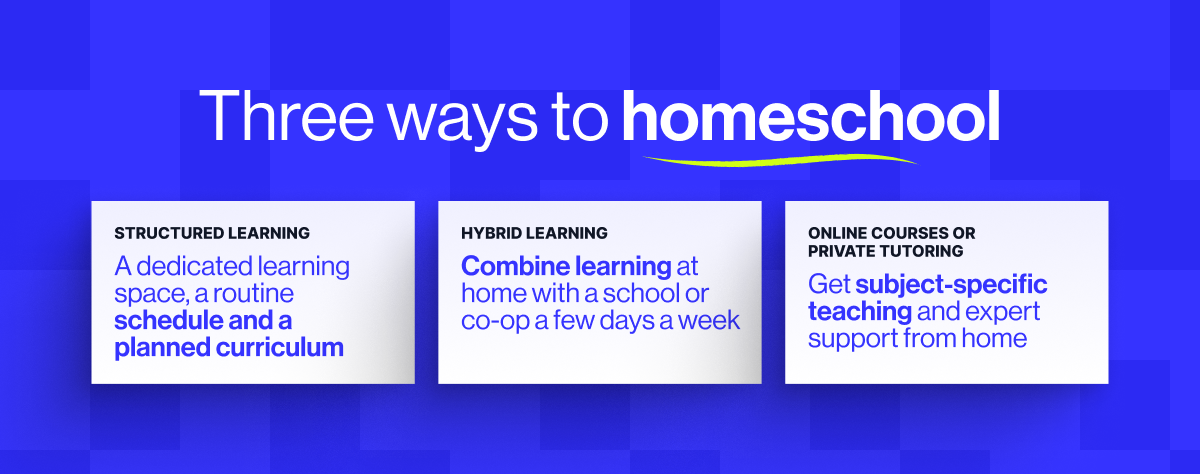
To help you get started, the three main approaches to homeschooling are: structured, hybrid, and in-person or virtual tutoring.
Structured homeschooling
Structured homeschooling mirrors a typical classroom, and usually requires a room at home dedicated to learning in which you follow a routine schedule.
When choosing a structured approach, you'll need to invest in textbooks, and get hold of worksheets, assignments, and tests to track your child's progress.
Examples of structured homeschooling include classical education (curricula like Classical Conversations and Memoria Press), Waldorf education, Montessori education, and the Charlotte Mason method.
Hybrid home and classroom learning
If you don't have the time to fully commit to structured homeschooling, there's the potential for hybrid learning, which combines going into a school or co-op a few days a week with studying at home.
One of the main benefits of hybrid learning is that it allows parents and caregivers to work part-time. It also means there's less pressure in developing a full curriculum, since some of the learning happens outside the home.
With hybrid learning, you may want to consider hiring a private tutor, or making the most of online courses like MyEdSpace, to free up time for yourself and benefit from some additional subject-specific expertise.
In-person or virtual tutoring
The third homeschooling method is to hire a private tutor, or sign up for an online home education course.
With private tutoring, it can sometimes be quite difficult to find the right tutors, and people often have to decide between cheaper, but less experienced, tutors or highly qualified ones that cost thousands of dollars per subject. The result is that for too long, families have had to choose between what works and what they can afford.
That's where MyEdSpace and our award-winning online education comes in.
By using technology and scale to cut overheads, we ensure every child from 4th grade through 12th grade can access top teaching talent at a fraction of the cost of hiring a private tutor.
Only the top 1% of teachers who apply to work with us are successful. That means that instead of a grad student looking to earn a few extra dollars, your child is learning from highly qualified teachers who've spent years honing their talent for educating future generations. With MyEdSpace, there's no compromise on quality - you're just not paying for empty travel time or inefficiencies. It's a 10x better education, at 10% of the cost.
By bringing people together, students also benefit from the experience of collaborative group learning - which is lost in 1-to-1 tutoring - from the comfort of their own home. First, learning alongside their peers encourages more questions and collaboration, boosting confidence, engagement, and energy levels, which can be lost in a more intimidating 1-to-1 setting where anxious students can feel "put on the spot."
It's not tutoring. It's not school. It's something better.
Don't just take our word for it. We have over 1,500 5-star reviews from parents and students on Trustpilot. And we offer limited money-back guarantees because we're so confident you'll love it.
Choosing the right home education curriculum
With MyEdSpace the hard work of choosing the right curriculum is done for you, as our online courses are all designed to cover 4th through 12th grade Math.
However, if a structured home education fits your needs better, then it's time to find the right curriculum.
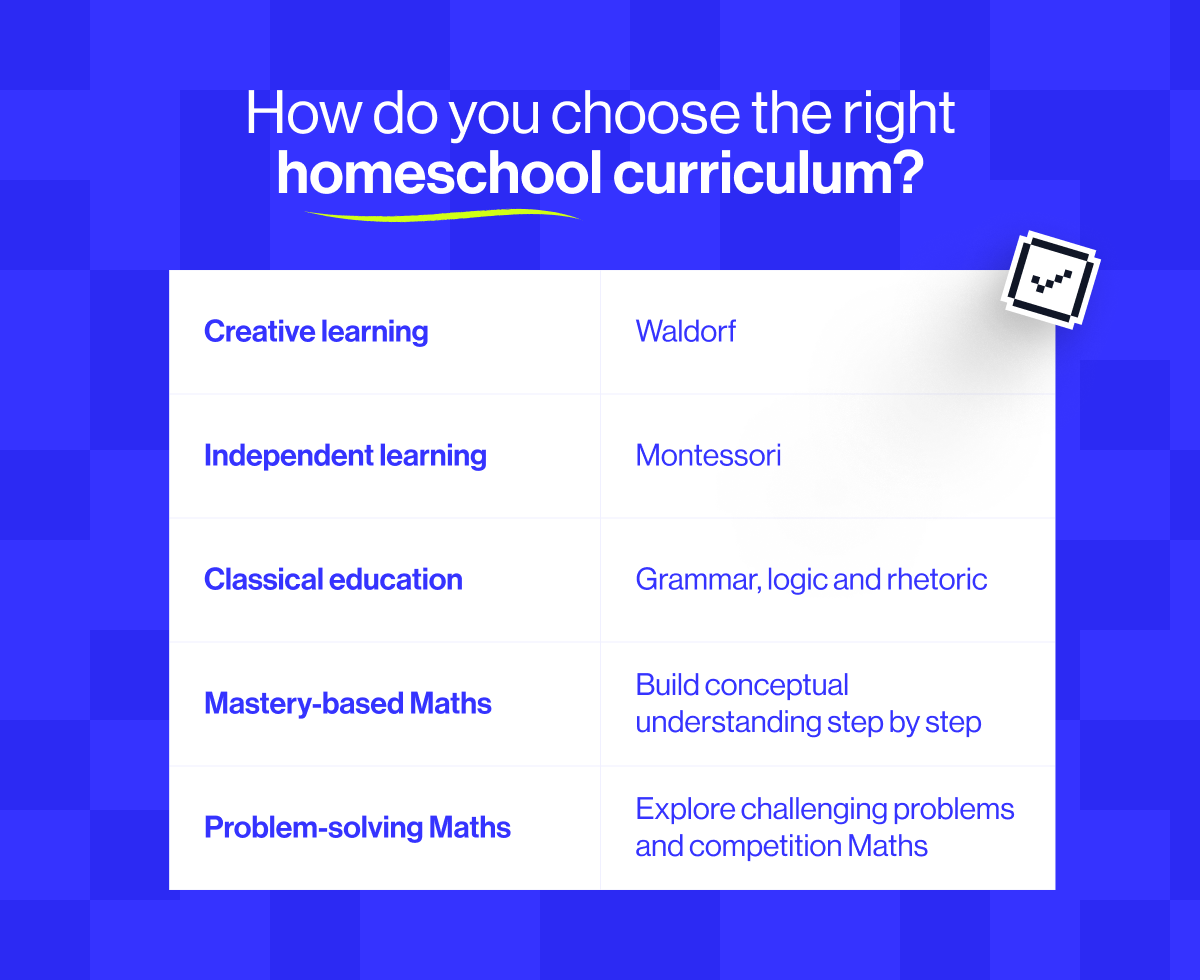
The first step is to consider the student's natural interests, and use them as a starting point. For example, Waldorf education focuses on creativity, while the classical method is centered around grammar, logic, and rhetoric. Both Waldorf and Montessori emphasize the importance of independent learning.
Math is one subject where homeschooling families put an especially large amount of thought into curriculum choice, since programs differ so much in approach. Popular options include:
- Singapore Math
- a mastery-based approach built around the concrete-pictorial-abstract method and bar modeling, widely used for building strong conceptual understanding in elementary grades. - Russian School of Mathematics (RSM)
- a rigorous, in-depth program (available in physical centers as well as online) popular with families preparing kids for competitive math or advanced STEM tracks. - Art of Problem Solving (AoPS)
- aimed at strong math students, especially in middle and high school, with a focus on problem-solving and competition math (AMC, AIME, MATHCOUNTS). - Saxon Math
- a traditional, spiral-review curriculum that continually revisits older concepts alongside new ones. - Math-U-See and RightStart Math
- mastery-based programs that lean heavily on hands-on manipulatives and visual models. - Beast Academy
- a comic-style, problem-solving-focused program for elementary grades from the same team behind AoPS. - Teaching Textbooks
- a video-based, more relaxed option that's popular for independent learners.
Beyond math, other widely used homeschool curricula and programs include Sonlight and Bookshark (literature-based), Abeka and BJU Press (traditional textbook-based), The Good and the Beautiful (Charlotte Mason-inspired), Classical Conversations and Memoria Press (classical), and Time4Learning and Power Homeschool (fully online, self-paced options).
That said, it's important you thoroughly research each one before committing - many curriculum publishers offer sample lessons or trial periods, and homeschool co-ops and Facebook groups in your area can be a good source of firsthand reviews.
Sitting exams independently
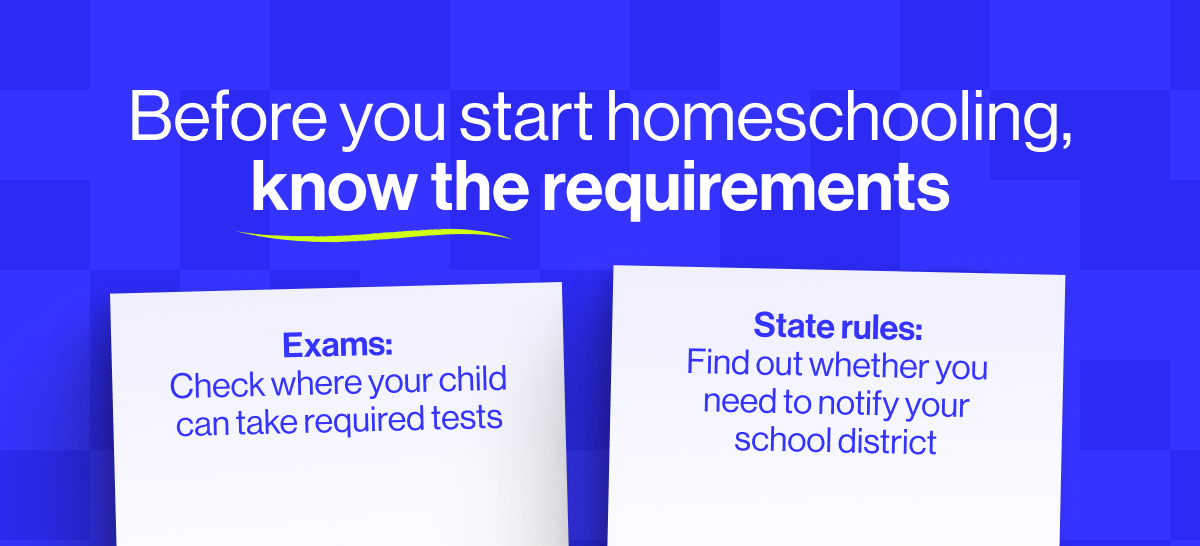
One other thing to consider with homeschooling is where the student can sit exams.
Requirements vary significantly by state. Many states require homeschooled students to take an annual standardized test (commonly through a testing service like Seton Testing or BJU Press Testing) or undergo another form of academic evaluation, while other states have no testing requirement at all. When it comes time for college applications, homeschooled students typically sit the SAT or ACT at an official testing center just like their peers in traditional schools, and can also take AP exams through a local school or approved testing site.
Notifying your school district
Finally, it's also important to remember that homeschooling rules are set at the state level, not nationally, so requirements vary widely.
If your child is currently enrolled in public school, you'll generally need to submit a formal withdrawal letter to the school before you start homeschooling. Beyond that, some states (like Texas, Alaska, and Indiana) require no further notification at all, while others (like New York and Pennsylvania) require you to file a notice of intent, and in some cases submit an annual education plan or portfolio for review. It's worth checking your specific state's Department of Education requirements, or a resource like HSLDA's state-by-state guide, before you begin.

Keep Reading
More from the blog
How do you find the nth term? An expert guide
Finding the nth term of a sequence is a fundamental skill in mathematics, essential for solving problems in algebra, calculus, and beyond.
Read article →Meet the TeamIntroducing Manhar Dalal
"I have my 8th Grade yearbook by my desk, in it they asked me 'What do you want to be when you grow up?' My answer was 'Math teacher' - so I have been on this train a long time," recalls a smiling new MyEdSpace math teacher Manhar Dalal.
Read article →